
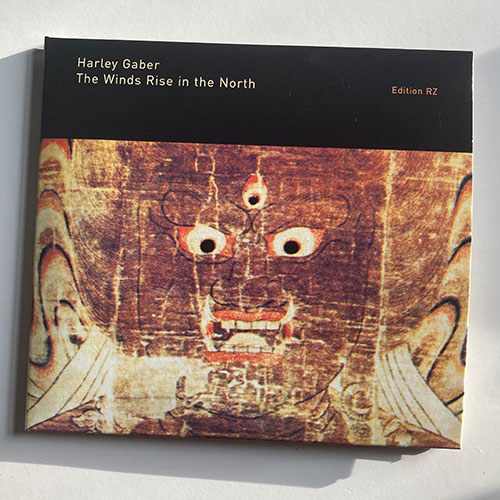
Perhaps due to hard drive mishaps and growing vulnerabilities around digital libraries and streaming music, we’ve slowly moved back to enjoying CDs and records again. Whilst having a library you can access anywhere is great, the most blindingly obvious thing we’ve enjoyed rediscovering is simply how amazing music sounds in an uncompressed format. Hearing music in the way it was intended, as a thick, chunky, nuanced, and present form is simply incredible.
Harley Gaber’s work is one of our newest discoveries, based on this rekindled love of physical formats. Thanks to the wonderful Edition RZ, perhaps his most essential work The Wind Rises in the North, has been rapidly moved from a chance purchase, into a towering presence in our turn of the year listening.
Clearly this review isn’t of a new release (save perhaps its recent quiet reissue), nor anything more than simply us being deeply inspired, after finally being exposed to the brilliance of Gaber’s works.
The piece itself was originally composed in the winter of 1973/74, before Gaber, perhaps deflated by little interest in his work, veered off into a career as a tennis player and coach. By the 80’s he’d also created momentum as a visual artist before returning to music in the early 2000’s. His earliest pieces, both this album, and its companion of sorts, Indra’s Net, enjoyed remastered releases, and two further albums of new music followed. This refocussing on music occurred as his health deteriorated, sadly taking his own life in at the age of 68 in 2011, only a fortnight after his last album ominously called In Memorium 2010, was released.
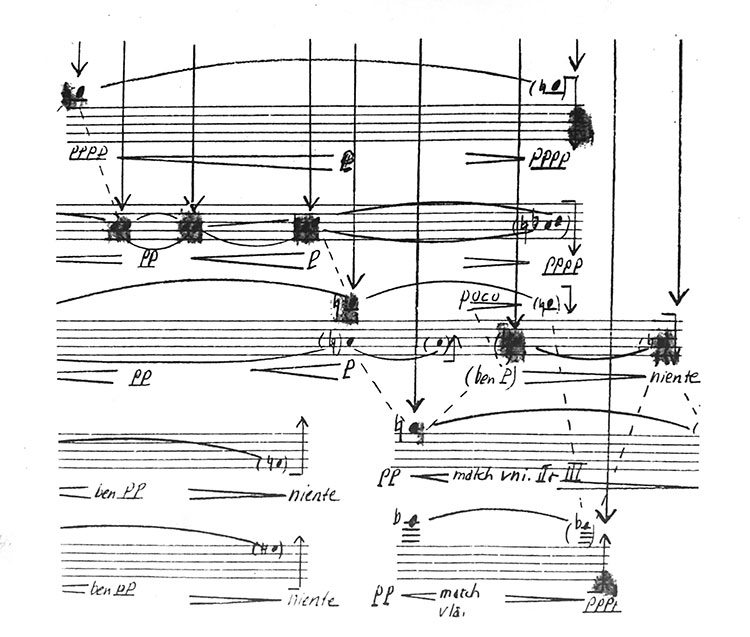
The Wind Rises in the North is a piece composed for a string quintet, performed by Linda Cummiskey (Violin), Malcolm Goldstein (Violin), Kathy Seplow (Violin), Stephen Reynolds (Viola), and David Gibson (Cello). This 2 CD set is a live recording from 1976, taken as part of a week-long session. Spread over four 25-minute-long parts, the sum total of its 100 minute lifespan has never failed to somehow intensify the gravity, whenever we have listened.
Growing out of a very human form of precision, the whole piece quickly aligns into a throbbing hurdy-gurdy-like mass of sound. The near statis of these instruments slowly gather into peaks of sound that balance on a razors edge between screeching chaos and beatific ecstasy.
As well as requiring huge concentration by the players, the piece also puts huge technical demands on the fairly basic recording equipment. Due to the overall dynamic arc of sound, elements of background noise, tape hiss and various rumbles and artifacts all gives a sense of the music, as a form of contradiction. Any given moment being both incredibly simple whilst simultaneously a dizzying mandala of overtones, notes, noise, and waving dials. Furthermore, the piece also offers yet more of its rich sonic characteristics to any listener, simply by choosing either a quiet, or loud playback volume.
Gaber centred the whole idea for the piece on a series of questions posed by Chinese philosopher Chung Tzu, the author of the Zhuangzi, a foundational text in Taoism.
How endlessly the heavens turn.
And yet the earth remains at rest.
Do the sun and the moon quarrel as to their positions?
Who rules over and orders all these things?
By whom are they in harmony?
Who effortlessly causes and maintains them?
Is there, perhaps, some hidden tension
that prevents them from being other than as they are?
Must the heavenly bodies move as they do, powerless to do otherwise?
Look how the clouds drop the rain!
And how the rain rises again to form the clouds!
Who moves them to this abundance?
Who effortlessly produces the primary orb and stimulates it?
The winds rise in the north and blow to the east and west.
Others move upward uncertainly.
Whose breath moves them?
Who effortlessly causes them to blow?
What is the cause?
Much like Chung Tzu’s most well-known tale about a man who dreamed of being a butterfly or a butterfly dreaming of being a man, The Wind Rises in the North also centres on a sense of apparent transformation.
Clearly this all works in various ways, between silence, and sound, stillness, and agitation. But in the numerous sweeps through this stunning work, it’s the simple fact the overall power is a richly detailed infinite beauty, that blossoms out of a few very exacting human gestures.
In that sense, The Wind Rises in the North follows that definition of minimalism where less means more. Whilst that is undoubtably true, this album seems to be a particularly potent example of the fact. Clearly driven by that belief, his entire 4 album discography meant he applied the same maxim to his entire musical output.
Despite the whole project being dusted in some sort of retrospective sadness, tuning in a full half century after The Wind Rises in the North was created, is a treat. An apparently challenging listen that quickly somehow feels both rudimentary and revelatory.
A work of endlessly blistering, and unique power.
Purchase 2xCD version of The Wind Rises in the North from Edition RZ
Also available from Boomkat and Soundohm, and other stockists.
Information on the original vinyl edition can be found here

 obladada.com