
Beyond making, performing and constructing music, preparing the resulting files for vinyl, CD or digital release, all comes to our ears via a myriad of shadowy technical processes. That much heard of, but somehow overlooked, confusing and misunderstood world of engineering and mastering.
How quiet are the quietest parts and how loud are the noisy bits? What subtle tweaks helps put the music in the best place to tell its story most effectively? Where certain instruments are placed in the stereo image, how thick the bass is, how much time has been spent in the set up as each element was recorded, how inventive the engineers, producers and technicians might be, and how open minded or trusting the musicians or labels are? From the outside, it seems to be an unmapped blend of hard technical knowledge, and human intuition and feel.
Whatever the actual reality is for those involved, they are highly skilled individuals, who are exposed to so many creative approaches. How certain atmospheres, textures, and effects are achieved, and how they are technicality handled to sculpt the final recording that pours out your speakers.
Since around 1997, Rashad Becker has mastered countless records. Living in Berlin, and until 2019, worked at Dubplates & Mastering, itself founded by Basic Channel, one of the most significant labels in the city’s vibrant techno and experimental electronic scene. Becker’s name has appeared in absolutely stacks of music we have loved for decades.
Perhaps in a way, as an active ingredient in so many other releases, you could imagine, actual music from Becker would have to navigate a certain internal critique. It would naturally need to sound utterly fantastic, be expected to be technically dazzling, and perhaps more challengingly, would point somewhere new, that none of the music he’s ever worked on went.
That imagined brief was smashed in both his previous mind-blowing albums, Traditional Music of Notional Species Vol. I (2013) and Vol. II (2016). Both these albums presented like the documentation of a new musical vocabulary. Each release gathering tracks under the banners of Dances and Themes. At no point in anything here, is it remotely apparent what is going on. A series of liquid abstractions informed by both some underlining rhythmic grid, and a layer of lyrical flourishes. The music is exacting but could be either micro composed or completely aleatory.
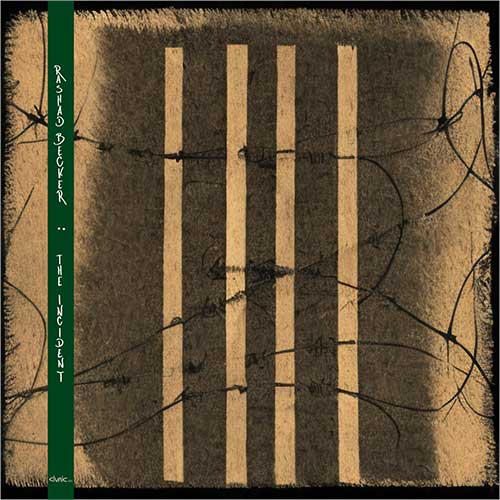
the incident however takes a far wider remit in scale and ambition. If his first two albums built the language, then now – we now start to speak and construct worlds with it.
This double LP takes advantage of the 4 natural side long sections in an elaborate and labyrinthian concept. Each side forms like a distinct act in some bizarre musical. But whilst it’s easy to quickly lose your way in this format, a simple listen through its 11 tracks, in 71 minutes, still quietly ties you in pleasant head bending knots. the incident is an invitation into some of the most otherworldly and captivating electronic sounds and environments we’ve heard.
The opener busy ready what, corroborators sends you into an immediately twisting elasticate rhythm, whilst a supposition darkly bends and shudders in thick smudges and distant clanks. of permanent advent, and all you need to know about confusion continue to defy any easy categorisation. We have music that has its origins in some form of electronic rhythms, but every sound grows out this spine at odd angles, lifted straight from Xenakis at his most abstract.
The next 4 tracks are perhaps the easiest to see as a conceptual quadruplet, zero hour, l’heure H, stunde null, and sāʿatu alṣṣufri, all sharing the same title but in English, French, German and Arabic. Playing with the notion of reworking core elements, remixing, as well as how these sounds follow or explode any idea of stereotypes. How does this music encapsulate a national identity, or does this say more about the artist or listener? l’heure H sounds like it eventually sends you on some microscopic flightpath through a wheezing accordion whilst, stunde null is packed with blocky impervious monoliths. sāʿatu alṣṣufri somehow interpolates into eastern musical forms leaking out a rattling percussive mountain of cutlery.
After the hallucinatory ceremony of a puttering purgation the final two tracks extend their footprints into two hugely adventurous drone-scapes. The 13 minutes of deadlock is a menacing drift into industrial throbs and wobbling bells. However, the final track, an almost 19-minute epic of what really happened, which builds into a fully realised lysergic reality. The space is littered with layers and fragments, everything meshing and breathing together but slipping and sliding apart. The shadow of brass, echoes bouncing off hard edges, and drowned in splattered gelatinous blobs – before the whole thing coagulates into a woozy bubbling jelly.
After a listen to the incident, it’s natural to be dazed. Everything drips in a mystery, devoid of anything approaching normality. There is no sense of where any sound came from, how they were made or manipulated. We are in the weirdest of zones but somehow everything here is utterly magnetising.
Whilst it’s not what everyone is looking for, here at OBLADADA, we love hearing sounds we haven’t heard before. It only takes a second to recognise Roland Kayn, Iannis Xenakis or Derek Bailey. This idea of a sonic signature clearly becomes more difficult as new ground to break becomes harder to find.
But somehow Rashad Becker has done just this over 3 spine tingling releases. the incident however pushes the bar even higher and without any doubt is one of the most impressive, out-there, completely wild and essential releases we’ve heard in some time.
the incident is a new and baffling form of spectacular.
the incident is out on clunk now
available digitally and on 2LP

 obladada.com