
It’s hard to believe that’s another collective year around the sun. Writing this in mid-December, and it feels like the end of a year that’s been a challenge for many. All the headlines seem to point to an ever more divided world. That orange sack of shit continues on his dumb and chaotic course, whilst here in the UK, the nonsensical racists grow in confidence. Wars and conflicts rage on, divisions widen, compromises feel out of reach, and it’s easy to feel a bit bruised and useless in all this wide-screen turbulence.
But it’s important not to give yourself such a hard time (as I often remind myself). It’s vital to try and remain positive, even if it’s only in regard to what you can actually influence and control yourself. Here, time with good people, and fortunately, countless hours in nature, shared moments with all the wild fungi and slime molds (another passion of mine), and all the wild little souls out there, living in the actual real world.
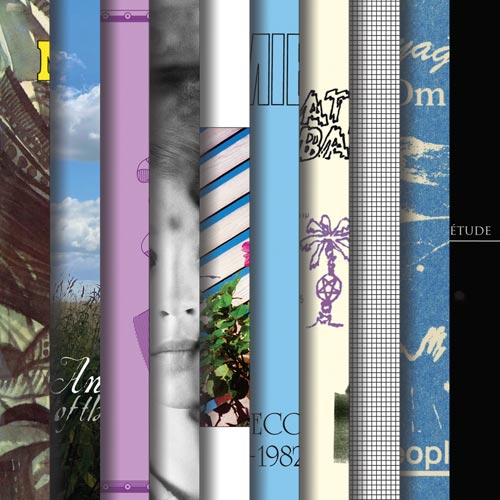
Music remains another huge part of this buffer from the ugly world, and our end-of-year list draws on music that didn’t grab as much attention as perhaps they deserved. But, each of these 10 albums listed below certainly remained significant in our listening.
In a way they are maybe slow burners, but gather into a pile of releases that just seemed to always be near to hand, brain and heart. Music played so regularly they became the ongoing foreground and background to our year…
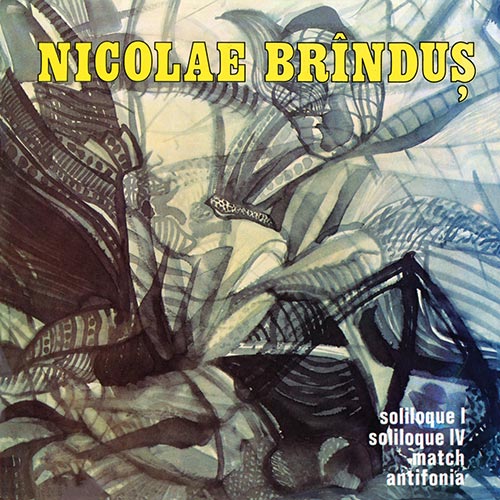
Nicolae Brînduş
Match / Soliloque 1&4 / Antifonia
Nicolae Brindus, was a new name to us but the Romanian composer, who spent years studying new music at Darmstadt, and worked in Paris’s IRCAM has become a recent obsession. An album, originally released back in 1986, which took only 10 wild seconds for us to take notice, and whilst its spiky weirdness is undeniable, it’s somehow sucked us completely into its unique form of delicious bedlam.
Brindus takes elements of folk music, free jazz, and orchestral fragments, creating a bubblingly odd, agitated form of cacophony. The first piece, the almost 20 minutes of Match is like a solid block of sound made from tiny sonic shards, a rapid stream of elements meshing from endless fragments. The music here forms like aural crosshatching, painterly scumbling and scribbles. The contents never settle, instead appearing to ferment and buckle into woozy drones as the composition stretches out.
Parts 1, 2 and 4 of Soliloque focus on more paired back sounds but the effect remains somehow way more engrossing than it should. Even traces of silence feel like the result of yet more accumulation of tiny individual units. The final piece here, Anifonia is the collection’s most skeletal – little more than droning bouncing strings that still dance between pure abstraction and folky lyricism.
It’s easy to assume this music makes a hard listen, but it quickly feels bizarrely welcoming. Match / Soliloque 1&4 / Antifonia, in this newly remastered form may have appeared late in 2025 but it’s been a record we have adored exploring since the moment we discovered it.
Crazy and ultra weird, but utterly engrossing stuff.
FIND OUT MORE/PURCHASE: Match / Soliloque 1&4 / Antifonia

Anthony Child
of the Beginning
Creating any sort of art is cathartic in a sense. A response to something and a means of leaving a selection of carefully considered marks in your chosen medium. Anthony Child’s latest album has a somewhat lowercase, almost apologetic feel to it, a collection of music that you sense the prolific artist needed to make to get through certain times.
Child lists the equipment used, but also the emotions he drew on in these 7 extended tracks. A tribute to a lost loved one, cast against a difficult year, a messy mixture of grief, despair, gratitude, hope and love.
Child is a celebrated electronic musician (as Surgeon) but we best know and love him as one half of the ever-stunning Transcendence Orchestra with Dan Bean. He also oversees the rich creative artery that is his label Old Technology. However – of the Beginning feels like a far more personal and vulnerable project. These pieces convey the act of filling time making them, building, construction and playing them was a required distraction from lingering sadness. This music – a form of healing.
But rather than some overtly personal deep dive, of the Beginning quickly grows into a universal form of the human experience – that magic way that good music always makes any shitty situation, a tiny, or huge bit better.
Waking from a dream is deeply psychedelic ambience, whilst Are you being served? and Outsight form into a full 25-minute arc of feverish and excitable dub. Shipwrecked and Gloaming float by like shards of sunbeams dancing with gloomy piano atmospherics. Lodestar is an anthem drawn in the night sky, whilst the closer – My head feels like an open window is a huge pleasing drift through smudged energy.
Everything here feels relatable, even the rural landscape on the sleeve feels like places we all know, that hold unique and exact significances. of the Beginning is about very specific things, but made both understandable and beautiful to anyone that cares to tune in…
Despite it being a very recent addition to our collection, it’s an 80-minute chunk of positivity that’s already happily sliced through December’s storms and darkness.
FIND OUT MORE/PURCHASE: of the Beginning

Gerard Herman &
Christoph Heemann
Project Pope
Christoph Heemann has been a name that I’ve been aware of for decades. Featuring alongside Jim O’Rourke in projects like Mimir, as well as collaborations with Edward Ka-Spel, Limpe Fuchs and Current 93.
In the last few years, he’s been someone we’ve started to explore more fully, and everything we’ve heard so far have all seemed to burn slowly and brightly. 2020s Lebenserinnerungen eines Lepidopterologen + is a vast labyrinthine album that despite countless listens, never fails to surprise me every time it plays. Atmospheric, patterned, and hugely creative guitar music that somehow finds dozens of new ways to organise itself into simple forms, no one else has chanced upon.
End of an Era from 2023 is deep zones and kosmiche rhythms, like Besombes/Rizet’s masterpiece Pôle, partially reimagined 50 years later.
But his most recent release Project Pope, a collaboration with Gerard Herman is the one for this list, despite being almost 2 years old.
Part 1 takes murky piano loops and encases them in an even thicker haze. It’s easy to think this will just roll out like a standard ambient album but of course, that not where this duo takes us. The keys do remain through its 21-minute duration but are quickly submerged into a spectacular vat of bubbling magma and abstraction.
Part 2 begins more dynamically as wonky strummed guitar patterns rise out of the shimmers. It builds into a clanking mechanical epiphany before imploding into thick silence after only 6 minutes. From here, the piece then reforms itself into a paste of throbbing piano atoms that slowly enlarges in weird trippy eddies. Everything feels like it’s running backwards as it rolls on, before you unexpectedly discover what feels like a fog-bound cityscape deep inside the fabric of sound.
Project Pope is a dense adventure drawn in the thickest, most syrupy sonics. The album may well approximate the mirage of ambient, but its subtlety and undeniable quality, makes it a stunning example of psychedelic drift music.
One to live with, and unlock…
FIND OUT MORE/PURCHASE: Project Pope
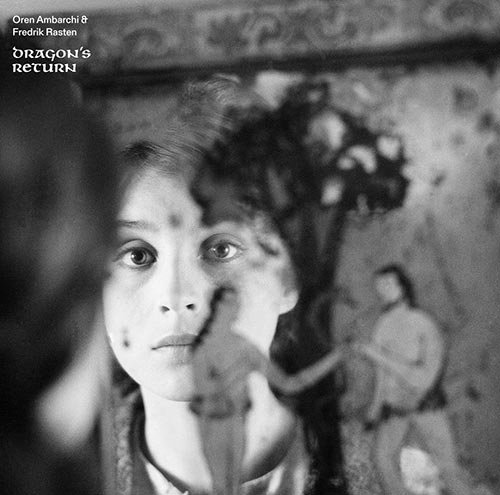
Oren Ambarchi &
Fredrik Rasten
Dragon’s Return
Oren Ambarchi has for years been a pivotal character to a chunk of mind-blowing music. The dizzying releases of his Black Truffle label, is an ongoing treasure chest of the most interesting new music and archival releases.
It’s sometimes easy to lose track of his own hugely prolific discography. On this release, Ambarchi teams up with guitarist Fredick Rasten, and the results are spectacular.
This album forms a new meta-score to Eduard Grečner’s eponymous 1967 Slovak cult film – Dragon’s Return. We haven’t seen a frame of this film beyond the record sleeve, but what we have is a stupendous, spacious and illusionary masterpiece.
Built from a host of instruments – guitars, flutes, percussion, and voice, Part 1 grows out of misty stillness into folky blossoms, and strummed caverns. Subtly shifting layers grow along with the sense of something ready to energise.
This glorious suspense eventually gathers into the tumbling droning nirvana of Part 2. Its first 12 minutes, a soaring joy which eventually disintegrates into mandalas of Leslie speaker throbs, crackles and eventually just a sense of buzzing warmth…
Dragon’s Return only implies the rhythms that feature so prominently elsewhere in Ambarchi’s discography, but this zero-gravity folk infused variant is unmissable.
FIND OUT MORE/PURCHASE: Dragon’s Return
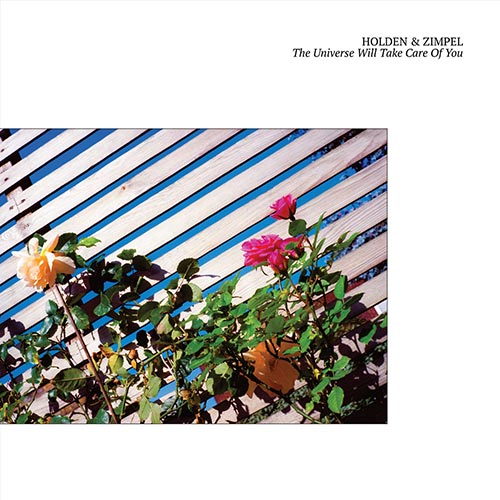
Holden & Zimpel
The Universe Will Take Care Of You
James Holden’s last major release was the magnificent Imagine This Is A High Dimensional Space Of All Possibilities back in 2023. An album that was a flythrough of the memories, good times and phases of dance and electronic music. It’s still an album that burns superbly.
Holden’s discography is littered with collaborations, groups of players and different settings, and back in 2020, released an EP Long Weekend with Polish clarinettist Waclaw Zimpel. Whilst this release was great, it felt like it was just the starting point of the melting of their individual sounds.
Perhaps the intervening years have allowed things to mesh and dissolve more effectively, as the duos first full length release – The Universe Will Take Care Of You is a pure euphoric warp out.
The whole album immediately feels like it’s huge. The opener You Are Gods is waves of sparkling arpeggios, voices and looping clarinet. It’s music that hypnotises, demands you to zone out, and then fly across its rippling horizons.
Sunbeam path takes 9 whole earth minutes to tumble towards stasis, whilst Time Ring Rattle is a flurry of spinning pulses and impeccably controlled mayhem. Sparkles, Crystals, Miracles is thick vast space. Even on our initial play-through back in a vibrant June, it was clear this album would be one to revisit countless times. Incredible Bliss comes on like a stroboscopic flythrough of the forest, and the closing and title track is a huge emotive wave of tingling surges and pulses. An epic hymn that makes you soar…
The Universe Will Take Care Of You is, in fact, a 51-minute-long celebration of something ungraspable but completely understood.
Holden’s music somehow always transports me to warm weather and long summer nights, a nostalgia for a night club or festival past I never really experienced first-hand. Even during Scotland’s current grimiest and shortest days, The Universe Will Take Care Of You somehow still beams like the most potent soundtrack ever, like a huge buzzing daylight bulb in the darkness – a searingly good sonic mood enhancer.
FIND OUT MORE/PURCHASE: The Universe Will Take Care Of You
Costin Miereanu
Poly-Art Recordings 1976-1982
We wrote about Poly-Art Recordings 1976-1982 back in June when it was released. Often the fact we’ve listened so hard and intensively to a recording for reviewing means we give ourselves time to reflect afterwards.
However, this album, despite its size and scope, was somewhere we’ve just continued to live inside. Whilst it’s extremely convenient as a morning/afternoon /evening’s worth of sounds, it’s just as good taken as x12 – 20 minute long micro adventures.
Perhaps what makes this collection so utterly majestic is the simple concept at its core. Each track is a side-long improvisation within a particular equipment and instrumentation setup. The palette is restricted, which means all the light and shade, any dynamics or drama, is teased out of the finest margins.
Every track here is a bubble worth savouring, a different planet to linger on. Our review at the time suggested Poly-Art Recordings 1976-1982 was ‘a trippy electronic masterpiece‘.
A full 6 months of listening later, we are even more certain of that fact.
FIND OUT MORE/PURCHASE: Poly-Art Recordings 1976-1982

PAINT &
Matt Baldwin
Cherry Lagoon
Whilst this list unintentionally features several collaborations, they can often be less than the sum of their parts. That excitement about two or more artists you like joining forces may become something that misfires or fails to explode like you’d have hoped for, in your imagination.
Thankfully, this seemingly low-key release – Cherry Lagoon – causes no such deflation. The brightly focussed psych-pop of PAINT and wide screen atmospherics of Matt Baldwin – somehow blended into an unexpected album of twisted deep space textures. Here both artists left whatever they normally do, at the studio door, and stepped into the thickest lysergic soup.
Dead Ringer is notes bouncing and bending in blurring woozy arcs. Cherry Pie is like a field recording of a dream as it fragments and dissolves into ambient weirdness. The final 20-minute track Stucco Planets plots vectors between oily masses of sound and bleeping reflections like earliest (and best) phase Kraftwerk jamming with a spiked Robert Fripp.
Even now, Cherry Lagoon feels like the oddest and most interesting result that anyone could have hoped for, from this particular Venn diagram.
And whilst we are in this part of the musical universe – Matt Baldwin’s NEW UNIVERSAL SOLAR CALENDAR, also from this year, is another huge recommendation.
FIND OUT MORE/PURCHASE: Cherry Lagoon here and here
Max Eilbacher
7 Runs (in arc mental styling)
Baltimore’s Horse Lords are easily one of the most interesting groups working right now in our opinion. An avant-rock band that happily draw on all the sort of stuff my heroes mapped out. Their recent collaboration with Arnold Dreyblatt is a perfect case in point – a supergroup we might previously have only dreamt about.
But Horse Lords strength also goes beyond their group activities. Whilst still seemingly overlooked, Owen Gardner’s Sammusik, which we described in our review as ‘human catnip’ back in 2021, is one of our all-time favourite albums. But this year’s – 7 Runs (in arc mental styling) by the group’s bassist, Max Eilbacher is another stunning highlight.
The title track 7 Runs (in arc mental styling), is built from electronics that feel like new sonic ground being broken. A twinkling, tumbling, bleeping, shiny stream of dazzling pulses. A rhythmic grid where every single element is continually slipping and sliding, fluid and melting, but still locked in space. The illusion of something, and the suggestion of something else.
Like his band activities, the heart of this music clearly grows out mathematical knowledge, conceptual rigour and electronic sophistication but 7 Runs (in arc mental styling) easily becomes an enthralling and magnetic 18-minute mind blower.
The second track, another 18 minutes, is The Third Part of the Night, which takes similar shards and organises them differently. Clouds of elements interpolate; gradual intensities reach dizzying points of saturation before unfolding into static silence.
7 Runs (in arc mental styling) is a beautiful example of music that sounds unlike anything else. Easier to visualise as a line of code or an impossible object than a performance, but whatever is actually going here is absolutely gorgeous and head spinningly spectacular.
Experimental music that’s bursting with excitement.
FIND OUT MORE/PURCHASE: 7 Runs (in arc mental styling)

Crystal Voyager
& UFOm
Universe People
Universe People feels like a flythrough of the same space as Tim Robertson’s Outer Planertary Church Music (an album of music composed to be played in churches on Saturn and Neptune).
This album comes wrapped in a similar heady concept that’s easy to grasp. The soundtracking of an alien civilisation coming to earth to impart some universal wisdom. Whilst it’s the narrative outlined in countless science fiction books and films, this mysterious duo of Crystal Voyager & UFOm give you the impression, here at least, that this is based around a kernel of genuine belief.
According to the label, UFOm’s identity is a secret, as they are involved high up within a religious organisation. Things are made more significant, given the fact that their previous album Aliens are Real, clearly seems to outline the same extra-terrestrial doctrine.
Wherever you may stand in all this, Universe People is a beautifully detailed adventure. A broadly new age tinged 40 minutes that gently conveys a sense of interdimensional transformation. The overall story starts in a dreamy utopia, but as the visitors begin to enmesh, things become literally more alien.
The bright twinkling of Harmonious Contact and columned light beams of Coarse Vibrations slowly give way to the bleeping transmissions of Microchipped. The ominous wobbliness of Flying Saucers Have Landed and odd new reality of Scout Craft convey things are very different now.
But the album ultimately reaches its zenith in the 7 and half minute closer Angel from Spiritually Advanced Civilization. A deeply spaced reimagining of first contact, enrobed with crystallised fanfares and echoing strangeness.
As a piece, viewed as either esoteric science fact, or simply a psychedelic dream, Universal People is an album that’s light as air but deeply rewarding…
FIND OUT MORE/PURCHASE: Universal People
TOMO
ELECTRONIC ÉTUDE
Japanese artist TOMO has made several records we’ve loved. He features as part of the wild trio archeus but his solo guitar explorations, and more often his hurdy gurdy works have zoned us into a space between folk forms and intergalactic drones. So, when ELECTRONIC ÉTUDE was released in May, it broadly felt like a generous insight into an experiment. Étude, I checked means study, so the idea was presumably just to share the results of an exploratory play around with a modular synth setup.
However, it’s clear pretty quickly that ELECTRONIC ÉTUDE frames TOMO, trying to approximate the sounds and structures like he’s still playing his beloved hurdy gurdy. But those long sonic tendrils become a blistering stream of buzzing sublime electronics.
Before long, the whole thing catches fire, throbbing and expanding like Keith Fullerton Whitman at his most third eye watering. Waves of droning layers, packed and bejewelled with millions of fizzing fragments, building into peaks and layers. Everything is in a flux of stasis and momentum, as new edges and forms keep emerging endlessly.
Part 1 is almost 30 minutes of a lethally potent drone whist Part 2 dares to chop itself into acid-etched rhythmic figures. This framework then gets blasted and anodised with wave after wave of soaring toxic peaks. A music that’s equally at home on your headphones, art gallery or the most fucked up nightclub imaginable, as it swells like a psychedelic supernova.
ELECTRONIC ÉTUDE feels like TOMO has kept things simple, perhaps even naïve, but superbly teased out a world previously just out of grasp. An album to play as loud as you dare, to get utterly hypnotised by, and will leave you pinned to the nearest wall, sofa or floor – a journey ending where you’ll be dazed, but very glad you made.
It’s staggering stuff, and it’s our tiny and earth-based honour to name as our album of the year…
FIND OUT MORE/PURCHASE: ELECTRONIC ÉTUDE

 obladada.com