
It’s fair to say the world doesn’t feel like a very relaxed place right now. The actions of one person seem to have the whole world on edge on a day-to-day basis, and the news channels, and social media all help paint an anxiety inducing picture.
One thing that’s always been useful is the safety blanket of access to nature and music. If you’re fortunate, they become two perfect and endless buffers, to remind you that positivity, ingenuity and ripples of brain excitement still exist.
Whilst musicians always have some sense of how they want an audience to feel; the best listens often focus in on very specific things. The palette of sounds or textures, words and themes that gravitate around a viewpoint, a nucleus of players, a desire and a creative dream. Art that becomes a very uniquely realised place, you can choose to step inside and give it as much or as little focus as you wish, whenever and wherever you want.
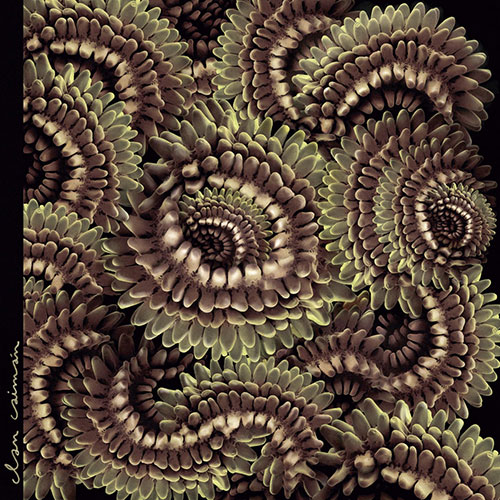
Whilst it would be ridiculous to suggest the whole weight of today’s world pivots on listening to Pica-Pau by Clan Caimán’s most recent album, but this music thankfully helped us rise above the noise every time it’s played. Released in September 2024, and despite a brief 32-minute run time, this random discovery, only a few months ago, has been on heavy rotation ever since.
Pica-Pau is the third album (the only one that we have heard so far) by the Argentinian group Clan Caimán, led by composer Emile Haro. The sounds core is mapped out by a kalimafon, a tuned percussion instrument made by Haro. The bouncy rhythmic grid of this sound source is then meshed and blended with lap steel / baritone guitar (Gonzalo Córdoba), percussion (Diego Voloschin), electric guitar and bass (Claudio Iuliano).
The opener Tulipán, loops the night forest with a plodding post rock twang before slowly sinking into a bath of gently bending electronics. Next up, the title track Pica-Pau rolling in with yet more pronounced rhythmic markers and lap steel as the whole thing slowly morphs into thick unexpected dub, pecked at with odd details.
Tripa is like peak Cluster, jamming around a pinging elastic band, whilst Andanza is hallucinatory gallop through the sunbeams. Laika is another potent groove that’s slowly corroded via a web of electronic smears. El Pantano is thick funk, deep in the jungle, whilst Duelo is a brief meditation of an almost still throb gathering around the kalimafon.
The final track, Tulipán Song, is a vocal version of the opener composed in a made-up language by Haro and sung by Catarina Goldenstein. Like the music, the sound and shape of the words, and her accent makes the whole thing feel like its beamed in from some future radio station, a new genre contained within one track.
Whilst the final track is perhaps the one that demands the most attention, it’s the preceding 7 tracks that burn the brightest. Percussive, rhythmic and pattern focused music sometimes becomes a bit of a technical showcase – all technique but no story. But here, whilst tracks all feel initially like they might somehow be exercises, all springboard and blossom into thick and vibrant conclusions. Fun music that seeps creativity. Throughout, subtle electronics seem to turn the fixed points and solid foundations, into reflective, bouncy and bendy ones…
Pica-Pau zones in and explores a very specific marriage of sounds but somehow quickly reveals an unexpected other world immediately adjacent to here. Music that when it’s played, always demands your brain and ears to forget whatever else is happening, and just listen.
A breaking news banner – but about oddly captivating sonic building blocks from Argentina. Pica Pau is curious, playful and very welcome music…
Pica-Pau is released on EM Records and is available on vinyl, CD and as a digital download here.

 obladada.com