
Thinking back to my earliest adventures with music, as a teenager, I’d moved from Bowie and the Beatles, Pink Floyd and King Crimson towards the weirder sounds at the outer fringes of rock music.
Discovering that, the wildest music was often sitting next to the calmest and most refined, in the classical section of the shops at the time. Next to Beethoven and Mozart and dozens of other household names, was all sorts of strange stuff. A whole layer of dense and complex recordings, regularly featuring pianos, strings and orchestras but regularly chopped up with electronic effects, tape collages and, regularly no sense of traditional rhythm or melody. Music, I didn’t understand but music I also couldn’t stop listening to. Albums like John Cage’s Indeterminacy or Karlheinz Stochausen’s Kontakte, where two early leaps into the unknown that reveal a fissure still open in my mind to this day. A music far wider reaching and wild, than almost everything in the rock section.
Even now, it’s apparent that what I’ve always loved is sounds treated in unusual ways. How an instrument can make a sound which is then processed into a whole other dimension of possibilities. A key being pressed, a string bowed, a breath pushed through metal tubes, whatever way an object is played but then a host of other options mean the sound mutates…
Many of these types of recording resided in the sober environment of academia, wrapped in theory, complex musical language and early technology. But regarded simply as exploration and experimental music, they have been an absolute constant in my own adventure for decades.
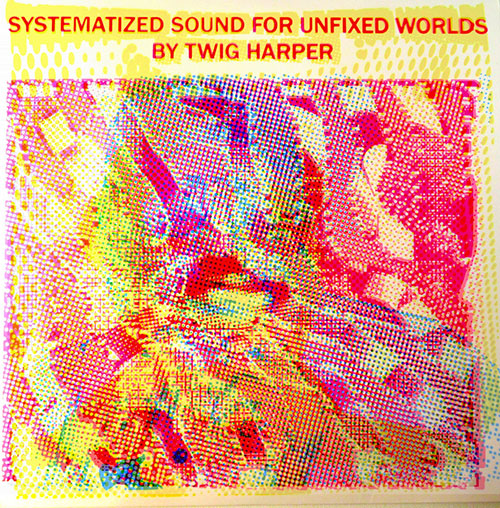
SYSTEMATIZED SOUND FOR UNFIXED WORLDS, the latest release by Twig Harper, whilst recorded this year, a blind test could easily have fooled me into being a previously unearthed gem from 1968. A record quite possibly made by well researched nerds with access to a huge bank of vintage equipment at some open minded university, that heady summer they also discovered acid…
Far from being a dig, SYSTEMATIZED SOUND FOR UNFIXED WORLDS is a superb listen. An ever-evolving delight of sounds tumbling and regenerating in space. The first section of Part 1 is a fractalized piano, the sound stretched, boiled, fried and sliced. In fact, over 4 minutes in, the instrument looms in unadorned, is the most arresting moment as a temporary wormhole links back to reality, then rapidly closes. The rising swell of strings is quickly masked in a wall of electronic curtains, nothing settles into any kind of reality other than a matrix of shapeshifting flux.
Part 2 is even more fractured, a hyperactive reshuffling of everything so far, agitated and organised into strings of infinite sonic Venn diagrams.
After sending the listener into freefall, as the album ceaselessly morphs, the thought arises what might an unfixed world be, or what are systemized sounds? The idea somehow develops that each sound here grew from a sound originally considered classical. But then these fragments and splinters of the real world all end up forced through a bank of effects that opens them out into huge liquid chasms of abstraction.
SYSTEMATIZED SOUND FOR UNFIXED WORLDS becomes a hallucination in pure sound. The ordered and logical showcasing of different tangents and arcs all carefully piled on top of each other. The result, a 31-minute adventure that groups thousands of possibilities, arranged into palettes of colour, formed into a snaking ribbon of bubbling exhilaration.
Harper has always made fearless and far-reaching music. An artist that’s never settled into any set way of making music, beyond always leading a listener towards some form of heady lysergic realm. SYSTEMATIZED SOUND FOR UNFIXED WORLDS is a superbly dynamic imagining of just that.
SYSTEMATIZED SOUND FOR UNFIXED WORLDS is out now digitally and on vinyl


